
What I Buried to Survive
The Birth of a Mother, Pt. 3

Logging into Zoom, a headache was forming on the left side of my skull. My stomach rumbled - already unsettled from the morning - and my palms were slick with sweat as I adjusted my screen, trying to find a flattering angle while my laptop wobbled on two pillows.
I didn’t even notice these things at the time. My mind was too loud to hear my body.
I hate therapy.
Therapy hasn’t worked before.
Will this work? Will she like me? Will she judge me for what I tell her?
What will I tell her?
I recited my story over and over again in my head. The one I had written on her questionnaire before the session even started.
I had a difficult pregnancy. I dealt with daily anxiety and depressive episodes. I struggle with guilt and letting go of the past. I get frequent chest pains that won’t go away. I’ve seen a couple of talk therapists and a psychiatrist, but nothing has helped. I was recently physically assaulted, which has worsened my anxiety. I want to be mentally healthy for my son.
My heart pounded as the screen filled with the image of a kind-looking woman in her fifties. With a gentle smile and an endearing British accent, she introduced herself as Fiona and told me about her work.
She asked why I was seeking help. I repeated what I had rehearsed. She told me she could help. I felt relief.
Everything so far was familiar territory - until the second session.
Fiona asked me to recall a recent “glimmer” - a small moment that sparked something positive. It could be as simple as going for a walk, drinking my favorite tea, or petting a dog.
It was a simple task, yet as I flipped through my recent memories, I came up blank.
Blushing with embarrassment, I told her I had taken out the trash that morning, and it had been windy. I love wind.
She asked me to describe how it felt. Physically.
When I struggled to answer, she gently prompted me: “Your dress whirling around your legs. Your hair whipping across your face. The cool air brushing your skin.”
I couldn’t really remember what it felt like, but it sounded familiar, so I nodded.
Then she asked me how my body felt inside.
Inside? I had no idea. I had only been used to noticing when I felt something was wrong. Chest pains, headaches, upset stomachs - I could name those. But when nothing was wrong… what was I feeling?
As my silence stretched, shame crept in. I wanted to give her the right answer. I didn’t want her to think I was stupid.
That was the beginning of realizing how disconnected I was from my body and from the words to describe it.
When she asked how I felt emotionally, I struggled to say anything beyond mad, sad, or happy.
When I mentioned my chest pains, she asked me to describe the sensation. I said it felt “bad,” and she gently corrected me.
“Not how you feel about the pain, but how it feels. Is it heavy or light? Large or small? Twisting, tightening, piercing?”
It all felt so foreign, and I hated that it didn’t come naturally. I hated how stupid I felt stumbling over my answers.
But slowly, I started opening up about what I was going through. What I had been through.
Fiona had a way of gently probing, in a way no other therapist had before.
In previous therapy, I always said I’d had a great childhood. Sure, my parents got divorced, but I was happy about that. And yes, my dad spanked me once or twice, but that’s normal in the U.S., right? Definitely not trauma.
My other therapists had accepted these answers. But not Fiona.
I’d been reading How to Do the Work by Nicole LePera. When she described the signs of anxious attachment, I was stunned. It was me. Everything made sense - my clinginess in relationships, tolerating abuse, my fear of being alone.
But it also left me confused. I loved my parents. We were close. Still are close. So how could I have developed anxious attachment?
Through therapy, buried memories began to surface. Moments from the divorce. Being yelled at for leaving toys out or arguing with my sister. I knew my parents had fought a lot, though I only remembered one argument clearly - when my mom broke a window.
I began to understand how, from a young age, I learned to dissociate to feel safe. Even if I wasn’t directly involved, I internalized the fear, the instability, and it left its mark.
When I couldn’t remember more details, I asked my sister. She remembered much more. She told me we used to retreat to my room and watch my lava lamp when our parents fought. I don’t remember that.
My mom also suffered from chronic migraines, which worsened after I was born. She would be bedridden for days. Sometimes the medication made her mean. I can’t remember the specifics. Just that it happened.
My sister said I would quietly play with my toys, pretending nothing was wrong. No wonder it took me so long to face these memories. I hadn’t even faced them back then.
We were often told to be good.
Mom isn’t feeling well, so be good.
You have to go to Grandma’s, so be good.
I internalized this deeply. I strove to be perfect. But perfection is impossible. At school, if I forgot my homework, I would cry and ask to go home, claiming I didn’t feel well. I couldn’t handle the disappointment.
As I got older, I turned to alcohol. Binge drinking became my weekend escape. I loved the release, the numbness.
Eventually, I realized I wasn’t drinking for the right reasons. I quit completely.
But that meant facing reality and all the things I’d done that weren’t “good” or “perfect.” That reckoning led to a mental health spiral, which contributed to a difficult pregnancy. And now, here I was, back in therapy. Full circle.
Somatic therapy gave me strength. The courage to face my past, and the tools to calm my body when it feels unsafe or triggered.
I wish I could say I’m healed. But healing isn’t linear.
What I can say is this: the past doesn’t haunt me the way it used to. When something feels off in my body, I try to explore it without judgment. When I’m overwhelmed, I have tools to help me calm down.
And for that, I’m eternally grateful.
Thank you for reading my story. This essay is a continuation of The Birth of a Mother, Pt. 1 and Pt. 2.
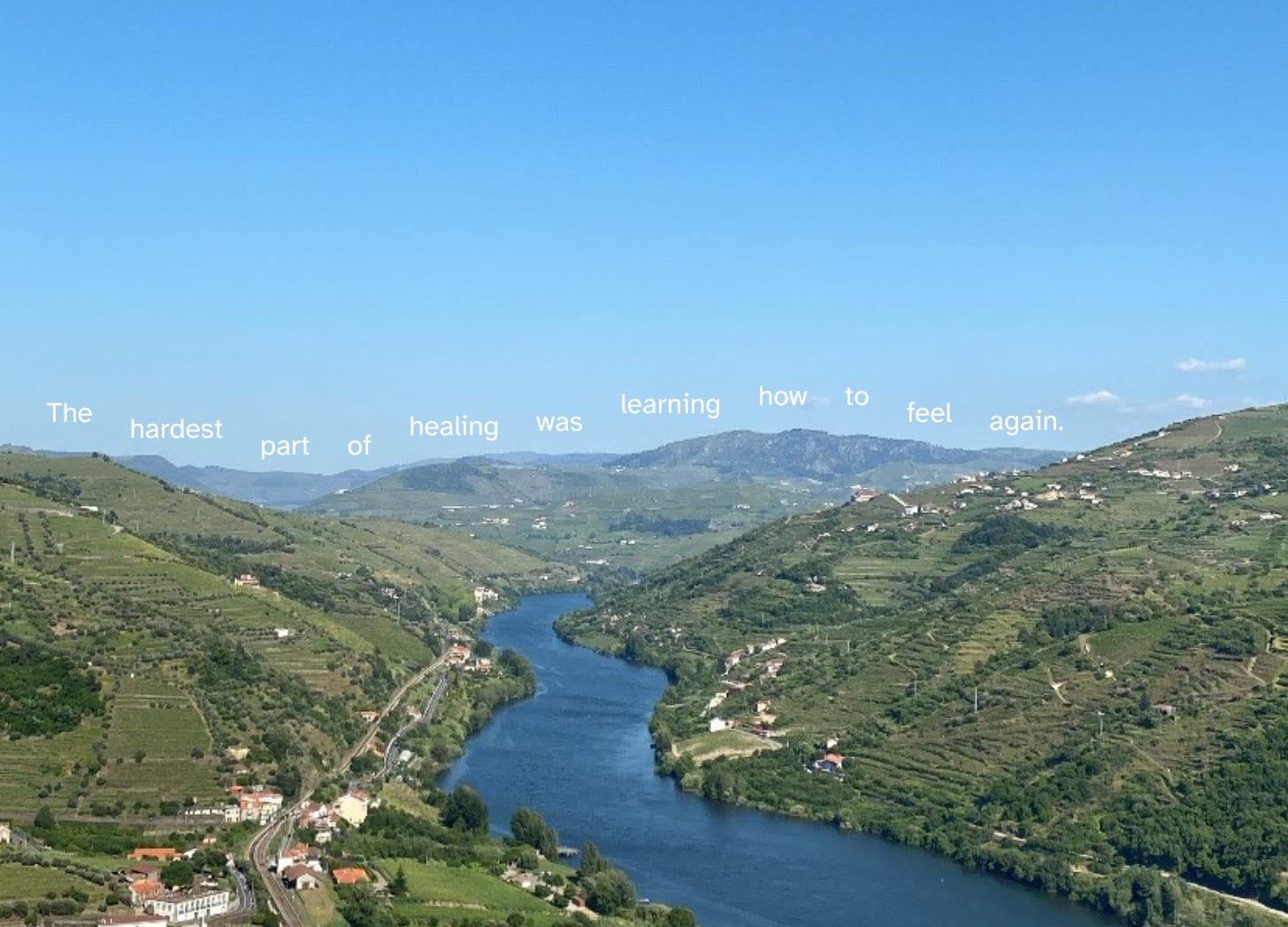
A special thank you to Emilie Rose Milling for providing the feature photo!
Everyone's journey is different, and what works for me might not work for you - but if you're curious about my somatic coach, Fiona Smith, and her work, here is her website.
i really liked how you talked about your pastin a real reflective way. the lava lamp, the “be good” thing, the migraines, the guilt, AAAAA it all makes sense. the confusion about loving your parents but still being affected is so real:( people think it’s either “trauma” or “a happy childhood,” but it can be both. this is beautiful!!
Suzi, girl I relate to so much of this. Love the story, creatively told. Will read the next part. X